
Make sure you're seeing what your customers see
Your own search can mislead you. Search Console's help says results are specific to the time, place, device and recent history of the person searching, and Google says it can bring a page you've visited before to the top of your results. Search for your trade from your office, on the laptop you use to check your own website, and you may be looking at different results from the customer across town on their phone.
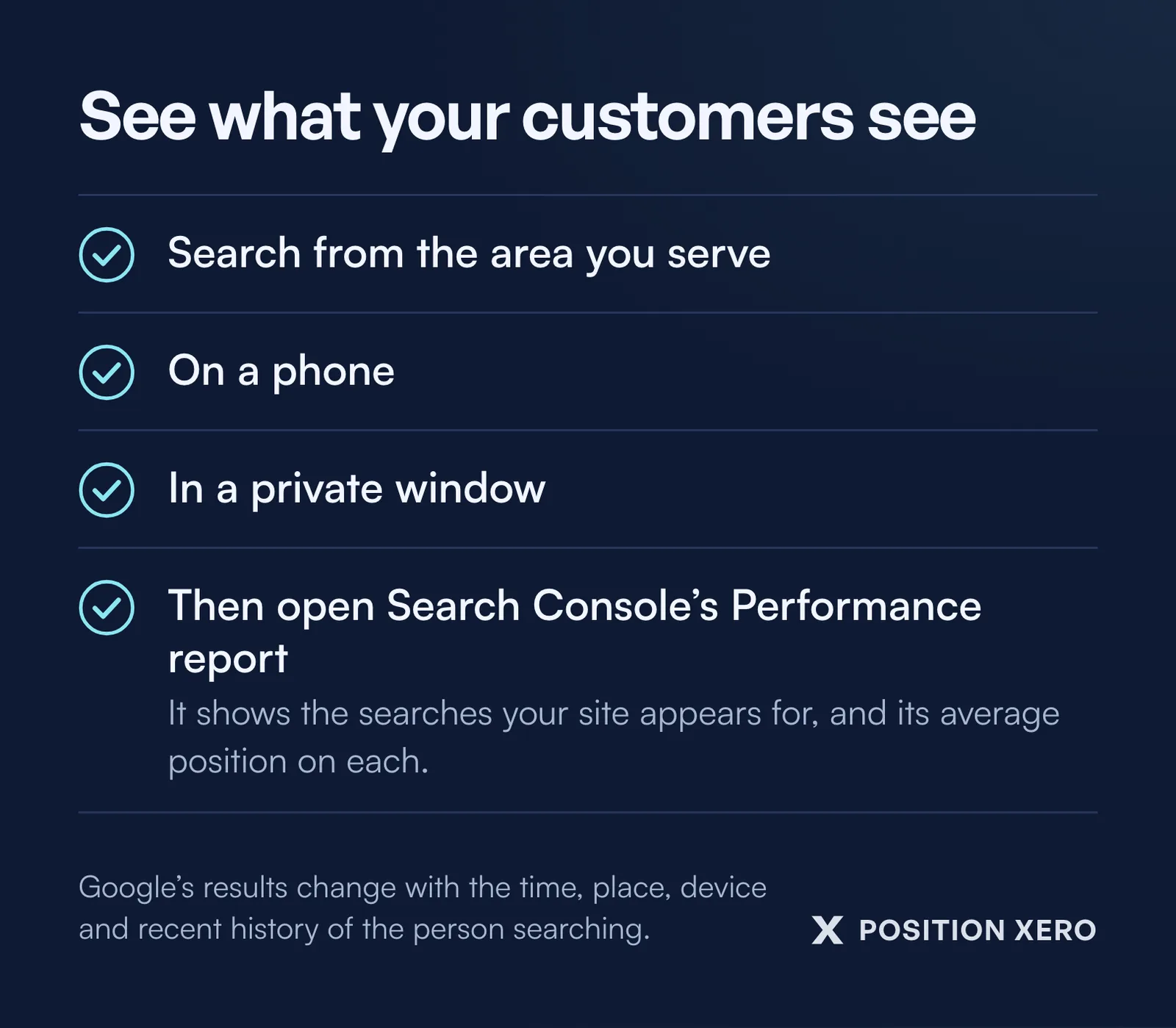
There are better ways in. Search from the area you serve, on a phone, in a private window. Then open the Performance report in Search Console, which shows the searches your site appears for and its average position on each. That tells you which searches you're close on, so you compare yourself with the right competitor on the right search.
If your page doesn't appear at all, check that Google has indexed it before anything else. Our guide to getting your business on Google walks through that setup.
Put their page and yours side by side
Open the page that shows above you, then open yours, and go through these checks. Write down what you find, because the notes become your list of fixes.
- Does their page answer the search in its own words? Google's basic test of relevance is whether a page contains the words of the search, in its headings or body text, and then whether it has useful content beyond those words. If someone searched for your service and their town, look for a heading on their page naming both. Then look at yours. If your service only gets a line on your homepage, set that against a whole page about it.
- Is it the kind of page the search wants? Google works out the intent behind a search before it picks results, and the results page itself changes with it: Google's own example is that "bicycle repair shops" will likely show local results, and "modern bicycle" image results. If the page above you is a different kind of page from yours, the fix may be a new page rather than a rewrite.
- What does each result say before anyone clicks? The headline of a result is its title link, and Google builds it partly from the page's title and headings. Its SEO starter guide asks for a title that's unique to the page, clear and accurate, and suggests it can carry your business name and location. Read both headlines and descriptions as a stranger would. Which would you tap?
- Who is behind it? Google looks for signs of expertise, authority and trust, and counts other prominent websites linking to or referring to a page among them. Its questions for site owners ask whether a page shows clear sourcing and background about who publishes it, such as an About page. If their site shows who does the work, where they work and photos of real jobs, and yours shows a logo and a contact form, that's a gap.
- How does it work on a phone? Google says that when other signals are roughly equal, content people find more accessible may perform better, and it gives mobile-friendly pages that load quickly as its example. Open both pages on your phone, then run both addresses through Google's PageSpeed Insights. Keep it in proportion: Google also says good scores don't guarantee a top ranking.
- Does their page offer something yours doesn't? Google's self-assessment questions ask whether a page gives substantial value compared with the other pages in the results, and whether it shows first-hand expertise. Answers to the questions your customers ask on the phone, an explanation of how you quote, photos of your own work: these are things only you can add.
If they beat you on the map
The map results are a separate list. There Google ranks Business Profiles on relevance, distance and prominence, and says there's no way to pay for a better local ranking. Our guide to local SEO for service businesses covers that side.
Why copying their page won't close the gap
When you've found what the page above you does better, it's tempting to rewrite your page to look like theirs. Google's questions for site owners ask whether content avoids simply copying or rewriting other sources and adds real value of its own. What you can add instead is your own jobs, your own area and your own way of working.
Some of what you found is yours to fix straight away: a page for each service, a clearer title and heading, a phone number that works with a tap, a page that shows who you are. Other parts build slowly. Google says links from other sites happen naturally over time, and that you can encourage them by promoting your site.
Be wary of anyone who promises to put you above that competitor by a set date. Google's own page on hiring an SEO says no one can guarantee the top ranking.
How we look at the gap
When we take on local SEO for a South African business, our groundwork includes keyword and competitor mapping, alongside a technical audit, a Google Business Profile claim or clean-up and a citation audit. We set up analytics to count enquiries, so you can see whether a higher place brings in work. And if the comparison shows SEO is the wrong spend for you right now, we'll say so, and tell you whether paid search would get you there faster.
Run these checks on the search where a competitor beats you, then see what our local SEO services in South Africa cover.
Related articles
How to get your business on Google
The setup steps, from a Business Profile to Search Console and a sitemap.
Local SEO for service businesses
How the map results rank local businesses, and the work that moves them.
How long does SEO take to work?
What decides the pace of SEO, and why nobody can promise you a date.